
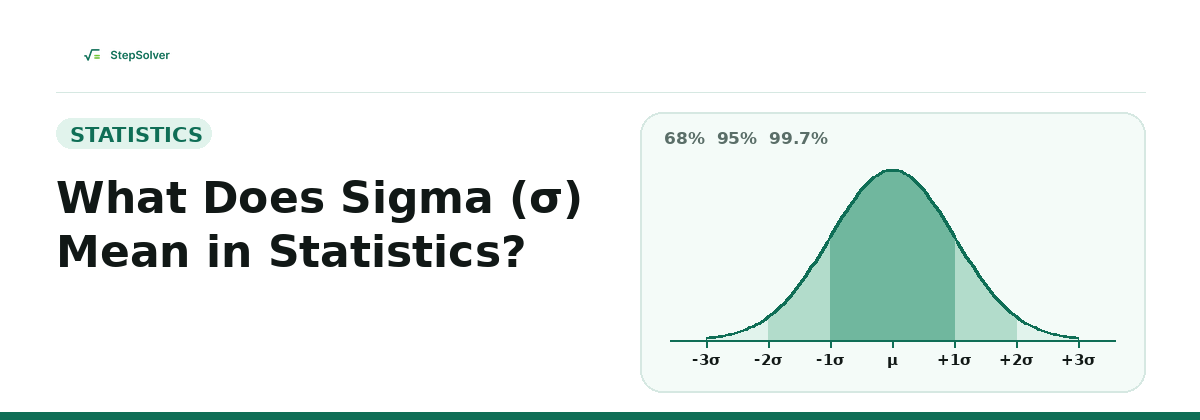
In statistics, the lowercase Greek letter sigma, σ, is the symbol for the population standard deviation. It tells you how spread out the values in a full population are around their mean. Its squared form, σ², is the population variance. The uppercase sigma, Σ, is a different symbol that means "add these up."
Sigma Symbols at a Glance
Sigma shows up in several forms, and mixing them up is the most common source of confusion. Here is what each one means:
| Symbol | Name | Meaning |
|---|---|---|
| σ | Lowercase sigma | Population standard deviation |
| σ² | Sigma squared | Population variance |
| Σ | Uppercase sigma | Summation, an instruction to add a list of terms |
| s | Lowercase s | Sample standard deviation |
| s² | s squared | Sample variance |
| μ | Mu | Population mean |
| x̄ | x bar | Sample mean |
A useful rule of thumb: Greek letters (σ, μ) describe a whole population, and Latin letters (s, x̄) describe a sample drawn from it.
The Sigma Formula
The population standard deviation is the square root of the average squared distance from the mean:
Both sigmas appear in that one line. The lowercase σ on the left is the answer. The uppercase Σ inside the root tells you to add up every squared distance. N is the number of values in the population, and μ is the population mean.
Worked Example: Finding σ
Suppose a class of eight students is the whole population you care about, and their quiz scores are 2, 4, 4, 4, 5, 5, 7, and 9.
- Find the mean: (2 + 4 + 4 + 4 + 5 + 5 + 7 + 9) ÷ 8 = 40 ÷ 8 = 5, so μ = 5.
- Subtract the mean from each value and square the result, as shown in the table below.
- Add the squared distances: Σ(x − μ)² = 32.
- Divide by N: 32 ÷ 8 = 4, which is the variance σ².
- Take the square root: σ = √4 = 2.
| Score (x) | x − μ | (x − μ)² |
|---|---|---|
| 2 | −3 | 9 |
| 4 | −1 | 1 |
| 4 | −1 | 1 |
| 4 | −1 | 1 |
| 5 | 0 | 0 |
| 5 | 0 | 0 |
| 7 | +2 | 4 |
| 9 | +4 | 16 |
| Total | 0 | 32 |
If those eight students were only a sample of a larger group, you would divide 32 by n − 1 = 7 instead, giving a variance of 4.5714 and a sample standard deviation of s = 2.1381. That is why s is always slightly larger than σ for the same numbers.
What 1, 2, and 3 Sigma Mean
People often say a value is "two sigma" from the mean. That simply means it sits two standard deviations away. For data that follows a normal (bell curve) distribution, the distance from the mean tells you how common a value is:
| Distance from the mean | Share of values inside |
|---|---|
| Within 1 sigma | About 68% |
| Within 2 sigma | About 95% |
| Within 3 sigma | About 99.7% |
This is called the empirical rule, or the 68-95-99.7 rule. As an example, suppose adult IQ scores are set to a mean of 100 with σ = 15. Then about 68% of people score between 85 and 115, about 95% score between 70 and 130, and about 99.7% score between 55 and 145. A score outside that last range is rare enough that it is often treated as an outlier.
How to Type the Sigma Symbol
- Windows: hold Alt and type 229 on the numeric keypad to get σ.
- Microsoft Word: type 03C3 and press Alt+X.
- HTML: write σ for σ, or Σ for Σ.
- Google Docs: choose Insert, then Special characters, and search for "sigma."
Common Mistakes to Avoid
- Confusing σ with Σ. One is a measure of spread and the other is an instruction to add. They look alike but are unrelated.
- Using σ for sample data. If your numbers are a sample, the correct symbol is s and the formula divides by n − 1.
- Applying the 68-95-99.7 rule to any data. Those percentages hold for normal distributions. Heavily skewed data can behave quite differently.
To calculate σ or s for your own numbers with every step shown, use our Standard Deviation Calculator. For the meaning of σ², read What Is Variance? and for the sample-versus-population split in more depth, see Standard Deviation vs Standard Error.
Frequently Asked Questions
- What does the sigma symbol mean in statistics?
- The lowercase sigma, σ, stands for the population standard deviation, which measures how far the values in a full population typically sit from the population mean. When it is squared, σ², it stands for the population variance.
- What is the difference between σ and Σ?
- They are two different symbols. Lowercase σ is the population standard deviation. Uppercase Σ is the summation sign, an instruction to add up a list of terms. In a formula such as σ = √(Σ(x − μ)² ÷ N), both appear, doing different jobs.
- Is σ the same as s?
- No. σ is used when your data covers every member of the group and s is used when your data is a sample. They are calculated in almost the same way, but s divides by n − 1 while σ divides by N, so s is slightly larger for the same numbers.
- What do 1 sigma, 2 sigma, and 3 sigma mean?
- They describe distance from the mean in standard deviations. For data that follows a normal distribution, about 68% of values fall within 1 sigma of the mean, about 95% within 2 sigma, and about 99.7% within 3 sigma.
- What does Six Sigma mean?
- Six Sigma is a quality management method that aims to keep defects extremely rare. Its usual benchmark is about 3.4 defects per million opportunities, which builds in an allowance for the process mean drifting by 1.5 sigma over time.
- How do I type the sigma symbol?
- On Windows, hold Alt and type 229 on the numeric keypad for σ. In Microsoft Word, type 03C3 and press Alt+X. In HTML, write σ. In Google Docs, use Insert, then Special characters, and search for sigma.
Related Articles
Read next: What Is Variance?, Standard Deviation vs Standard Error, SD in Excel, SD on a TI-84, Square Root Table, Volume Formulas, or browse all articles on the StepSolvers blog.