
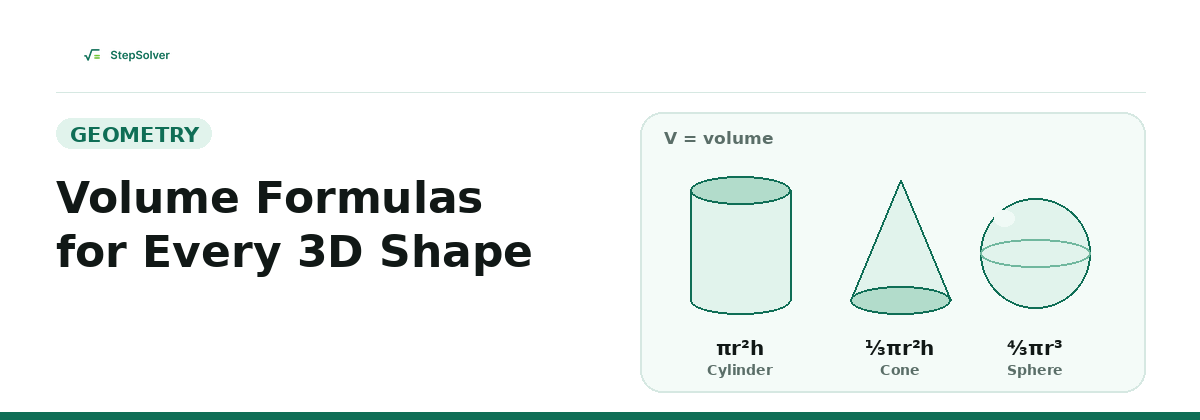
Volume is the amount of space a 3D shape takes up, measured in cubic units such as cm³, m³, or ft³. Every formula below is a quick lookup, and most are worked through with a real example further down. Two rules explain almost all of them: a prism or cylinder is "base area × height," and a cone or pyramid is one third of that.
Volume Formulas at a Glance
| Shape | Volume formula | What the letters mean |
|---|---|---|
| Cube | V = s³ | s = side length |
| Rectangular prism (cuboid) | V = l × w × h | length, width, height |
| Any prism | V = B × h | B = base area, h = height |
| Triangular prism | V = ½ × b × t × L | b = triangle base, t = triangle height, L = prism length |
| Cylinder | V = πr²h | r = radius, h = height |
| Cone | V = ⅓πr²h | r = base radius, h = vertical height |
| Pyramid | V = ⅓ × B × h | B = base area, h = vertical height |
| Sphere | V = ⁴⁄₃πr³ | r = radius |
| Hemisphere | V = ⅔πr³ | r = radius |
| Cone frustum | V = (πh ÷ 3)(R² + Rr + r²) | R = bottom radius, r = top radius, h = height |
| Capsule | V = πr²h + ⁴⁄₃πr³ | r = radius, h = height of the cylinder section |
Volume of a Cylinder
A cylinder is a circle stretched upward, so its volume is the area of the circular base multiplied by the height.
Example: a can has a radius of 3 and a height of 10.
- Square the radius: 3² = 9.
- Multiply by π: 9 × π = 28.274.
- Multiply by the height: 28.274 × 10 = 282.74.
If you are given the diameter, halve it first. A diameter of 6 gives the same radius of 3 and the same answer.
Volume of a Cone and a Pyramid
A cone takes up exactly one third of the cylinder that has the same base and height. A pyramid does the same against a prism.
Take a cone with r = 3 and h = 10, the same size as the cylinder above: V = ⅓ × π × 9 × 10 = 94.25. That is exactly one third of 282.74. For a square pyramid with a 6 by 6 base and a vertical height of 9, the base area is 36, so V = ⅓ × 36 × 9 = 108.
Use the vertical height, measured straight up from the base to the tip, and not the slanted side. If you only know the slant height, the Pythagorean Theorem Calculator can turn it into the vertical height.
Volume of a Sphere and a Hemisphere
For r = 3, cube the radius first: 3³ = 27. Then V = ⁴⁄₃ × π × 27 = 113.10. A hemisphere is half a sphere, so the same radius gives 56.55.
Volume of a Prism
Every prism follows the same idea: find the area of the base shape, then multiply by the height (or length) of the prism.
- Cube: a cube with sides of 4 has V = 4³ = 64.
- Rectangular prism: a box measuring 5 by 4 by 3 has V = 5 × 4 × 3 = 60.
- Triangular prism: a triangle with base 6 and height 4 has area ½ × 6 × 4 = 12. Stretched over a length of 10, V = 12 × 10 = 120.
Volume of a Circle or a Rectangle?
People often search for the "volume of a circle" or the "volume of a rectangle," but both are flat 2D shapes, so they have area rather than volume. A circle has area πr² and a rectangle has area length × width. Add a height and they become 3D: a circle with a height is a cylinder (πr²h), and a rectangle with a height is a rectangular prism (l × w × h).
Cone Frustum and Capsule
These two shapes are combinations of the ones above.
A frustum is a cone with its tip cut off. With a bottom radius R = 4, a top radius r = 2, and h = 6, the bracket is 16 + 8 + 4 = 28, so V = (π × 6 ÷ 3) × 28 = 175.93.
A capsule is a cylinder with a half sphere on each end. With r = 2 and a cylinder section of h = 6, the cylinder part is π × 4 × 6 = 75.40 and the two ends together make one full sphere, ⁴⁄₃ × π × 8 = 33.51. The total is 108.91.
Volume Units and Conversions
Volume is always in cubic units, so a length in centimetres gives a volume in cm³. To move between volume and capacity units:
- 1 cm³ = 1 millilitre (mL)
- 1,000 cm³ = 1 litre (L)
- 1 m³ = 1,000 litres
- 1 US gallon = 231 in³
Keep every measurement in the same unit before you multiply. If a box is 2 m long, 50 cm wide, and 40 cm high, convert to the same unit first (200 cm × 50 cm × 40 cm = 400,000 cm³, which is 400 litres).
Common Mistakes to Avoid
- Using the diameter as the radius. This makes the answer four times too big for a cylinder, cone, or any shape with r².
- Mixing units. Multiplying metres by centimetres gives a meaningless number. Convert first.
- Using slant height for a cone or pyramid. The formula needs the straight vertical height.
- Forgetting the one third. Cones and pyramids are a third of the matching cylinder or prism.
- Mixing up volume and surface area. Volume fills the inside in cubic units. Surface area covers the outside in square units.
To skip the arithmetic, our Volume Calculator handles the cube, sphere, cylinder, cone, rectangular prism, circle, frustum, and capsule, and shows the working for each. Several of these formulas involve squaring or cubing a number, and the Square Root Table is handy when you need to work backward from a volume to a radius or side length.
Frequently Asked Questions
- What is the volume of a cylinder formula?
- V = πr²h, where r is the radius of the circular base and h is the height. It is the area of the circle (πr²) multiplied by the height. For r = 3 and h = 10, the volume is 282.74 cubic units.
- Why is the volume of a cone one third of a cylinder?
- A cone that has the same base and height as a cylinder holds exactly one third as much, so V = ⅓πr²h. The same one third rule links a pyramid to a prism with the same base and height.
- How do I find the volume if I am given the diameter?
- Halve the diameter to get the radius first, then use the formula as normal. A cylinder with a diameter of 6 has r = 3, so with h = 10 the volume is still 282.74 cubic units.
- What is the volume formula for a sphere?
- V = ⁴⁄₃πr³. A sphere with a radius of 3 has a volume of 113.10 cubic units, and a hemisphere (half a sphere) with the same radius has half of that, 56.55.
- Is there a volume of a circle or a rectangle?
- No. A circle and a rectangle are flat 2D shapes, so they have area, not volume. The circle has area πr² and the rectangle has area length × width. Give either shape a height and you get a cylinder (πr²h) or a rectangular prism (l × w × h).
- How do I convert cubic centimetres to litres?
- Divide by 1,000. One cubic centimetre equals one millilitre, so 1,000 cm³ is 1 litre. In the same way, 1 cubic metre is 1,000 litres.
Related Articles
Read next: Square Root Table, Sigma Symbol Meaning, What Is Variance?, Standard Deviation vs Standard Error, SD in Excel, SD on a TI-84, or browse all articles on the StepSolvers blog.