
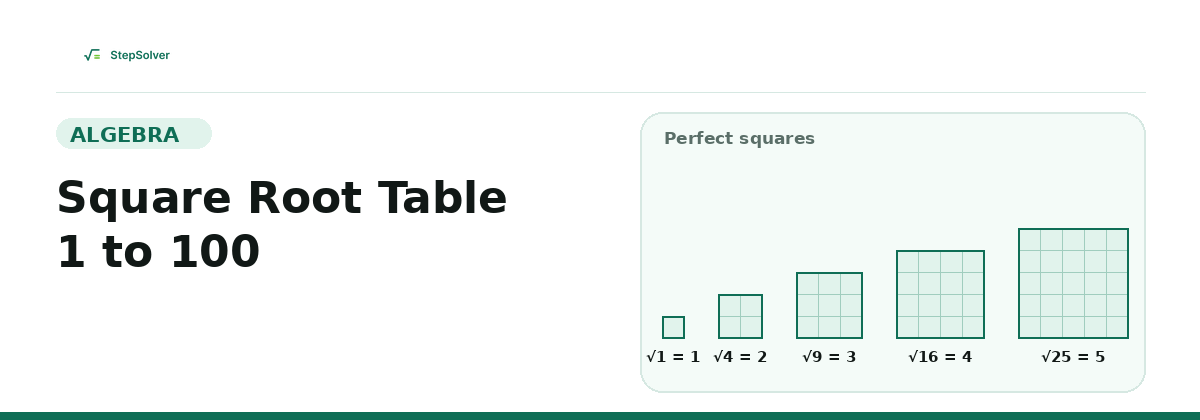
A square root table lists the square root of every whole number in a range, so you can look a value up instead of calculating it. The tables below cover 1 to 100. Perfect squares such as 4, 9, and 16 are in bold because their roots are whole numbers. Every other value is rounded to four decimal places.
Square Root Table From 1 to 30
This is the range most homework and exams draw from. The last column shows each root in simplified radical form, which is the exact answer your teacher usually wants.
| Number | Square root | Simplified form |
|---|---|---|
| 1 | 1 | 1 (perfect square) |
| 2 | 1.4142 | Already simplest |
| 3 | 1.7321 | Already simplest |
| 4 | 2 | 2 (perfect square) |
| 5 | 2.2361 | Already simplest |
| 6 | 2.4495 | Already simplest |
| 7 | 2.6458 | Already simplest |
| 8 | 2.8284 | 2√2 |
| 9 | 3 | 3 (perfect square) |
| 10 | 3.1623 | Already simplest |
| 11 | 3.3166 | Already simplest |
| 12 | 3.4641 | 2√3 |
| 13 | 3.6056 | Already simplest |
| 14 | 3.7417 | Already simplest |
| 15 | 3.8730 | Already simplest |
| 16 | 4 | 4 (perfect square) |
| 17 | 4.1231 | Already simplest |
| 18 | 4.2426 | 3√2 |
| 19 | 4.3589 | Already simplest |
| 20 | 4.4721 | 2√5 |
| 21 | 4.5826 | Already simplest |
| 22 | 4.6904 | Already simplest |
| 23 | 4.7958 | Already simplest |
| 24 | 4.8990 | 2√6 |
| 25 | 5 | 5 (perfect square) |
| 26 | 5.0990 | Already simplest |
| 27 | 5.1962 | 3√3 |
| 28 | 5.2915 | 2√7 |
| 29 | 5.3852 | Already simplest |
| 30 | 5.4772 | Already simplest |
Square Root Table From 31 to 100
Read each pair as a number and its square root. The table is arranged in three panels: 31 to 54 on the left, 55 to 78 in the middle, and 79 to 100 on the right.
| n | √n | n | √n | n | √n |
|---|---|---|---|---|---|
| 31 | 5.5678 | 55 | 7.4162 | 79 | 8.8882 |
| 32 | 5.6569 | 56 | 7.4833 | 80 | 8.9443 |
| 33 | 5.7446 | 57 | 7.5498 | 81 | 9 |
| 34 | 5.8310 | 58 | 7.6158 | 82 | 9.0554 |
| 35 | 5.9161 | 59 | 7.6811 | 83 | 9.1104 |
| 36 | 6 | 60 | 7.7460 | 84 | 9.1652 |
| 37 | 6.0828 | 61 | 7.8102 | 85 | 9.2195 |
| 38 | 6.1644 | 62 | 7.8740 | 86 | 9.2736 |
| 39 | 6.2450 | 63 | 7.9373 | 87 | 9.3274 |
| 40 | 6.3246 | 64 | 8 | 88 | 9.3808 |
| 41 | 6.4031 | 65 | 8.0623 | 89 | 9.4340 |
| 42 | 6.4807 | 66 | 8.1240 | 90 | 9.4868 |
| 43 | 6.5574 | 67 | 8.1854 | 91 | 9.5394 |
| 44 | 6.6332 | 68 | 8.2462 | 92 | 9.5917 |
| 45 | 6.7082 | 69 | 8.3066 | 93 | 9.6437 |
| 46 | 6.7823 | 70 | 8.3666 | 94 | 9.6954 |
| 47 | 6.8557 | 71 | 8.4261 | 95 | 9.7468 |
| 48 | 6.9282 | 72 | 8.4853 | 96 | 9.7980 |
| 49 | 7 | 73 | 8.5440 | 97 | 9.8489 |
| 50 | 7.0711 | 74 | 8.6023 | 98 | 9.8995 |
| 51 | 7.1414 | 75 | 8.6603 | 99 | 9.9499 |
| 52 | 7.2111 | 76 | 8.7178 | 100 | 10 |
| 53 | 7.2801 | 77 | 8.7750 | ||
| 54 | 7.3485 | 78 | 8.8318 |
Perfect Squares From 1 to 400
A perfect square is a whole number multiplied by itself. Knowing the first twenty on sight makes it much faster to spot which square roots come out clean.
| n | 1 | 2 | 3 | 4 | 5 | 6 | 7 | 8 | 9 | 10 |
|---|---|---|---|---|---|---|---|---|---|---|
| n² | 1 | 4 | 9 | 16 | 25 | 36 | 49 | 64 | 81 | 100 |
| n | 11 | 12 | 13 | 14 | 15 | 16 | 17 | 18 | 19 | 20 |
|---|---|---|---|---|---|---|---|---|---|---|
| n² | 121 | 144 | 169 | 196 | 225 | 256 | 289 | 324 | 361 | 400 |
Between 1 and 100 there are exactly ten perfect squares: 1, 4, 9, 16, 25, 36, 49, 64, 81, and 100.
How to Find a Square Root That Is Not in the Table
For a number outside the table, or one you want to a finer precision, find the nearest perfect square below it and use this estimate:
Here a is the whole number whose square is the closest perfect square below n. To estimate √50, use a = 7, since 7² = 49 and 8² = 64.
- Find the perfect squares either side: 49 is below 50 and 64 is above it, so the root sits just above 7.
- Work out the gap to the lower square: 50 − 49 = 1.
- Divide by twice a: 1 ÷ (2 × 7) = 0.0714.
- Add it to a: 7 + 0.0714 = 7.0714.
The estimate is off by only 0.0003, which is accurate enough for most quick checks.
Reading the Simplified Form
Simplified radical form pulls the largest perfect square out from under the root. For 18, the largest perfect square factor is 9, so √18 = √(9 × 2) = 3√2. Since √2 is about 1.4142, that is 3 × 1.4142 = 4.2426, which matches the table.
The same idea works for larger numbers. √50 = √(25 × 2) = 5√2, and 5 × 1.4142 = 7.0711, which matches the table value for 50.
Common Mistakes to Avoid
- Halving instead of rooting. The square root of 16 is 4, not 8. A square root undoes squaring; it is not division by 2.
- Forgetting the negative root. When you solve an equation such as x² = 25, both 5 and −5 are answers. The √ symbol alone gives only the positive one.
- Rounding too early. If a square root feeds into a longer calculation, keep the full value until the final step and round once at the end.
For a number that is not in these tables, our Square Root Calculator shows the full step-by-step working, including the simplified radical form. Square roots also drive statistics: standard deviation is the square root of variance, which is explained in What Is Variance?
Frequently Asked Questions
- What is the square root of 2?
- About 1.4142. It is an irrational number, so its decimal form never ends or repeats. In exact form it is written simply as √2.
- Which numbers from 1 to 100 are perfect squares?
- Ten of them: 1, 4, 9, 16, 25, 36, 49, 64, 81, and 100. Their square roots are the whole numbers 1 through 10.
- Why are most square roots in the table decimals?
- Only perfect squares have whole number roots. Every other whole number has an irrational square root, so the table rounds it to four decimal places. The rounded value is an approximation, not the exact answer.
- How do I find a square root that is not in the table?
- Find the two perfect squares on either side of your number, then estimate between their roots. For 50, the neighbours are 49 and 64, so the root is just above 7. The estimate 7 + (50 − 49) ÷ (2 × 7) gives 7.0714, close to the true 7.0711. For full working on any number, use the Square Root Calculator.
- Can a square root be negative?
- Every positive number has two square roots, one positive and one negative, because both 5² and (−5)² equal 25. The √ symbol means the positive one, called the principal square root.
Related Articles
Read next: What Is Variance?, Standard Deviation vs Standard Error, SD in Excel, SD on a TI-84, Sigma Symbol Meaning, Volume Formulas, or browse all articles on the StepSolvers blog.