
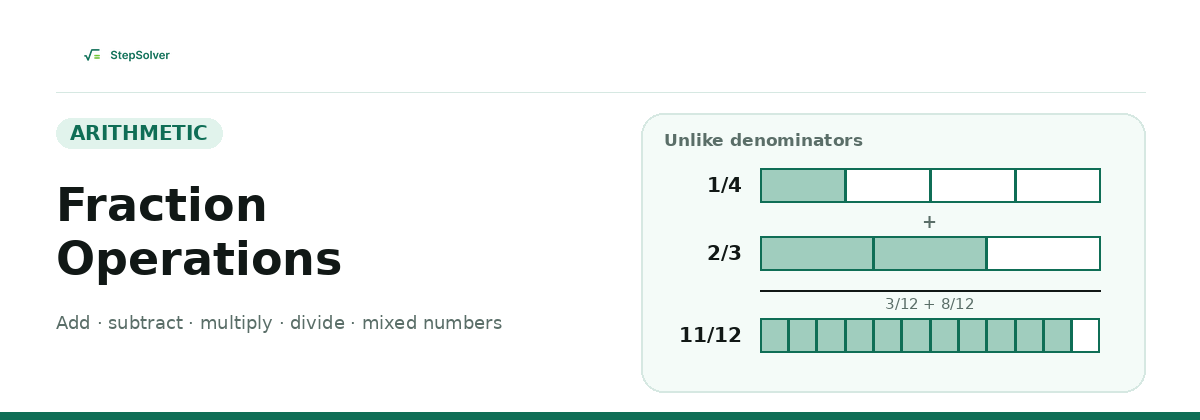
Fractions follow four simple rules, one for each operation. Adding and subtracting need a common denominator. Multiplying and dividing do not. This guide walks through each rule with a worked example, shows how to handle mixed numbers, and covers the mistakes that cost the most marks.
Parts of a Fraction
A fraction has a numerator on top (how many pieces you have) and a denominator on the bottom (how many equal pieces make a whole). In 3/4, you have 3 pieces, and each piece is one quarter.
Three more terms come up in every calculation:
- Proper fraction: the numerator is smaller than the denominator, such as 3/4.
- Improper fraction: the numerator is equal to or larger than the denominator, such as 7/4.
- Mixed number: a whole number and a fraction together, such as 1 3/4, which equals 7/4.
1. How to Add Fractions
Same denominator
When the denominators match, the pieces are already the same size. Add the numerators and keep the denominator.
Example: 2/7 + 3/7
- The denominators are both 7, so keep 7.
- Add the numerators: 2 + 3 = 5
Different denominators
When the denominators differ, rewrite both fractions so they share a denominator first. The smallest one that works is the least common denominator (LCD), which is the least common multiple of the two denominators.
Example: 1/4 + 2/3
- Multiples of 4: 4, 8, 12. Multiples of 3: 3, 6, 9, 12. The LCD is 12.
- Rewrite: 1/4 = 3/12 (multiply top and bottom by 3), and 2/3 = 8/12 (multiply top and bottom by 4).
- Add the numerators: 3/12 + 8/12 = 11/12
- 11 and 12 share no common factor, so it is already in simplest form.
Shortcut: if you cannot spot the LCD quickly, multiplying the two denominators always gives a common denominator. It may not be the smallest, so simplify at the end.
2. How to Subtract Fractions
Subtraction works exactly like addition. Get a common denominator, then subtract the numerators.
Example: 5/6 − 1/4
- The LCD of 6 and 4 is 12.
- Rewrite: 5/6 = 10/12 and 1/4 = 3/12
- Subtract the numerators: 10/12 − 3/12 = 7/12
3. How to Multiply Fractions
Multiplying is the easiest operation. You do not need a common denominator. Multiply straight across, top by top and bottom by bottom.
Example: 2/3 × 9/10
- Multiply the numerators: 2 × 9 = 18
- Multiply the denominators: 3 × 10 = 30
- Simplify 18/30 by dividing both by their greatest common factor, 6: 18 ÷ 6 = 3 and 30 ÷ 6 = 5
Cross-cancel to keep numbers small. Before multiplying, you can divide any numerator and any denominator by a shared factor. In 2/3 × 9/10, the 3 and the 9 share a factor of 3 (giving 1 and 3), and the 2 and the 10 share a factor of 2 (giving 1 and 5). That leaves 1/1 × 3/5 = 3/5 with no simplifying needed.
To multiply a whole number by a fraction, write the whole number over 1: 6 × 2/3 = 6/1 × 2/3 = 12/3 = 4.
4. How to Divide Fractions
Dividing by a fraction is the same as multiplying by its reciprocal, the fraction flipped upside down. Remember it as "keep, change, flip."
Example: 3/4 ÷ 5/8
- Keep the first fraction: 3/4
- Change ÷ to ×
- Flip the second fraction: 5/8 becomes 8/5
- Multiply: 3/4 × 8/5 = 24/20
- Simplify by dividing both by 4: 24/20 = 6/5
- As a mixed number: 6 ÷ 5 = 1 remainder 1, so 1 1/5
5. Working With Mixed Numbers
The safest method for any operation is to convert mixed numbers to improper fractions first, apply the normal rule, then convert back.
Adding: 2 1/3 + 1 3/4
- Convert: 2 1/3 = 7/3 and 1 3/4 = 7/4
- The LCD of 3 and 4 is 12: 7/3 = 28/12 and 7/4 = 21/12
- Add: 28/12 + 21/12 = 49/12
- Convert back: 49 ÷ 12 = 4 remainder 1
Subtracting: 4 1/5 − 1 2/3
- Convert: 4 1/5 = 21/5 and 1 2/3 = 5/3
- The LCD of 5 and 3 is 15: 21/5 = 63/15 and 5/3 = 25/15
- Subtract: 63/15 − 25/15 = 38/15
- Convert back: 38 ÷ 15 = 2 remainder 8
Converting first avoids the awkward "borrowing" step. Here 1/5 is smaller than 2/3, so subtracting the fraction parts directly would not work without regrouping.
Multiplying: 1 1/2 × 2 2/3
- Convert: 1 1/2 = 3/2 and 2 2/3 = 8/3
- Multiply: 3/2 × 8/3 = 24/6
- Simplify: 24 ÷ 6 = 4
Dividing: 2 1/4 ÷ 1 1/2
- Convert: 2 1/4 = 9/4 and 1 1/2 = 3/2
- Keep, change, flip: 9/4 × 2/3 = 18/12
- Simplify by dividing both by 6: 18/12 = 3/2
Quick Rules Table
| Operation | Common denominator? | Rule | Example |
|---|---|---|---|
| Add | Yes | Add numerators, keep denominator | 1/4 + 2/3 = 3/12 + 8/12 = 11/12 |
| Subtract | Yes | Subtract numerators, keep denominator | 5/6 − 1/4 = 10/12 − 3/12 = 7/12 |
| Multiply | No | Top × top, bottom × bottom | 2/3 × 9/10 = 18/30 = 3/5 |
| Divide | No | Flip the second fraction, then multiply | 3/4 ÷ 5/8 = 3/4 × 8/5 = 6/5 |
Whichever operation you use, finish by simplifying: divide the numerator and denominator by their greatest common factor until nothing but 1 divides both. To get the answer as a decimal or percentage, divide the numerator by the denominator. Our guide on how to calculate percentage includes a fraction to percent conversion table.
Common Mistakes to Avoid
- Adding the denominators. 1/2 + 1/3 is not 2/5. A quick sense check shows why: 2/5 is less than 1/2, yet you added something to 1/2. The denominator describes the size of the pieces, so it never gets added. The correct answer is 3/6 + 2/6 = 5/6.
- Finding a common denominator to multiply. It is not wrong, but it wastes time and creates bigger numbers to simplify. Multiplication and division never need one.
- Flipping the wrong fraction. When dividing, only the second fraction is flipped. 3/4 ÷ 5/8 becomes 3/4 × 8/5, not 4/3 × 5/8.
- Multiplying mixed numbers part by part. 1 1/2 × 2 2/3 is not (1 × 2) plus (1/2 × 2/3), which would give 2 1/3. The correct answer is 4. Convert to improper fractions before multiplying or dividing.
- Leaving the answer unsimplified. 18/30 and 3/5 are equal, but most teachers and tests expect simplest form.
Frequently Asked Questions
- How do you add fractions with different denominators?
- Find the least common denominator, rewrite each fraction with it, then add the numerators and keep the denominator. For 1/4 + 2/3, the LCD is 12, so 3/12 + 8/12 = 11/12.
- Do you need a common denominator to multiply fractions?
- No. To multiply fractions, multiply the numerators together and the denominators together, then simplify. 2/3 × 9/10 = 18/30 = 3/5.
- How do you divide fractions?
- Keep the first fraction, change the division sign to multiplication, and flip the second fraction. Then multiply. 3/4 ÷ 5/8 = 3/4 × 8/5 = 24/20 = 6/5, or 1 1/5.
- How do you work with mixed numbers?
- Convert each mixed number to an improper fraction first by multiplying the whole number by the denominator and adding the numerator. Then use the normal rule for the operation and convert the answer back if needed.
- Why can't you add the denominators?
- The denominator tells you the size of each piece, not how many pieces you have. 1/2 + 1/3 is not 2/5, because 2/5 is smaller than 1/2. The correct answer is 3/6 + 2/6 = 5/6.
- How do you multiply a whole number by a fraction?
- Write the whole number over 1, then multiply as usual. 6 × 2/3 = 6/1 × 2/3 = 12/3 = 4.