
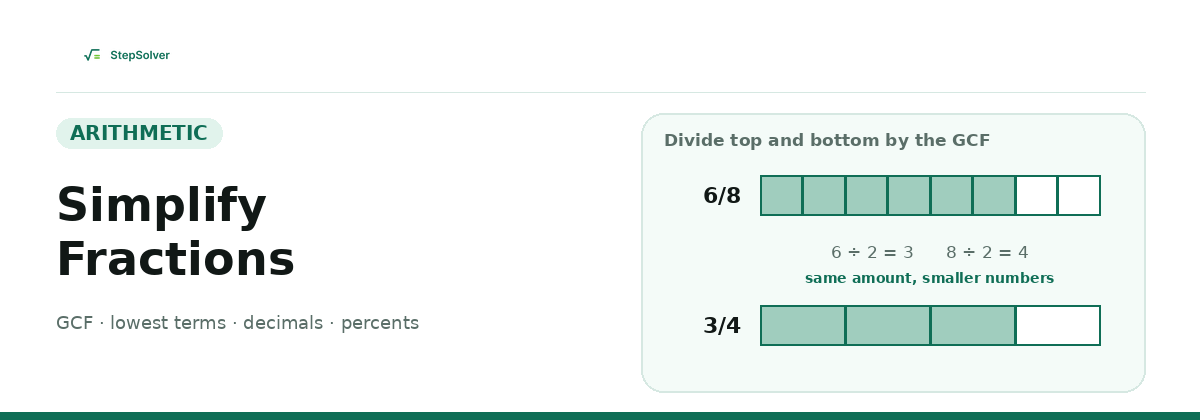
To simplify a fraction, divide the numerator and the denominator by their greatest common factor (GCF). The result is an equivalent fraction in its lowest terms. For example, 24/36 has a GCF of 12, so 24 ÷ 12 = 2 and 36 ÷ 12 = 3, giving 2/3. This guide shows three ways to find the GCF, how to simplify improper fractions and mixed numbers, a chart of common simplified fractions, and how to turn any fraction into a decimal or percent.
What Does Simplifying a Fraction Mean?
Simplifying (also called reducing a fraction or writing it in lowest terms) means rewriting it with the smallest possible whole numbers while keeping its value the same. 2/4, 3/6 and 50/100 all describe exactly half of something, and 1/2 is the simplest way to write that amount.
A fraction is fully simplified when the only number that divides both the numerator and the denominator is 1. So 3/4 is in simplest form, but 6/8 is not, because 2 divides both 6 and 8.
Method 1: Divide by the Greatest Common Factor
This is the fastest method when the numbers are small enough to list their factors.
- List the factors of the numerator.
- List the factors of the denominator.
- Pick the largest factor that appears in both lists. That is the GCF.
- Divide the top and bottom by the GCF.
Example: Simplify 24/36
- Factors of 24: 1, 2, 3, 4, 6, 8, 12, 24
- Factors of 36: 1, 2, 3, 4, 6, 9, 12, 18, 36
- The largest shared factor is 12, so the GCF is 12.
- Divide: 24 ÷ 12 = 2 and 36 ÷ 12 = 3
Method 2: Divide by Small Numbers Until You Can't
If you cannot spot the GCF straight away, keep dividing the top and bottom by any small number that goes into both, such as 2, 3 or 5. Stop when no number other than 1 divides both. You reach the same answer, just in more steps.
Example: Simplify 48/72
- Both are even, so divide by 2: 48/72 = 24/36
- Still even, divide by 2: 24/36 = 12/18
- Still even, divide by 2: 12/18 = 6/9
- 6 and 9 are not both even, but both divide by 3: 6/9 = 2/3
- 2 and 3 share no factor except 1, so stop.
These divisibility rules help you spot a shared factor quickly:
| Divisible by | Rule | Example |
|---|---|---|
| 2 | The last digit is even | 56 ends in 6 |
| 3 | The digits add up to a multiple of 3 | 84: 8 + 4 = 12 |
| 4 | The last two digits form a multiple of 4 | 316: 16 ÷ 4 = 4 |
| 5 | The last digit is 0 or 5 | 145 |
| 6 | Divisible by both 2 and 3 | 126: even, 1 + 2 + 6 = 9 |
| 9 | The digits add up to a multiple of 9 | 468: 4 + 6 + 8 = 18 |
| 10 | The last digit is 0 | 230 |
Method 3: Prime Factorization
For larger numbers, break the numerator and denominator into prime factors, then cancel the primes they share.
Example: Simplify 84/126
- Factor the numerator: 84 = 2 × 2 × 3 × 7
- Factor the denominator: 126 = 2 × 3 × 3 × 7
- Cancel the shared primes, one 2, one 3 and one 7: GCF = 2 × 3 × 7 = 42
- What is left: top 2, bottom 3
Very large numbers: the Euclidean algorithm
When factoring is hard, divide the larger number by the smaller and keep dividing by the remainder. The last non-zero remainder is the GCF. To simplify 391/667:
Simplifying Improper Fractions and Mixed Numbers
Improper fractions
Simplify an improper fraction exactly like any other, then convert it to a mixed number if you need one.
Example: Simplify 45/12
- The GCF of 45 and 12 is 3: 45 ÷ 3 = 15 and 12 ÷ 3 = 4, giving 15/4
- To write it as a mixed number: 15 ÷ 4 = 3 remainder 3
Mixed numbers
Leave the whole number alone and simplify only the fraction part. For 5 14/21, the GCF of 14 and 21 is 7, so 14/21 = 2/3.
Simplified Fractions Chart
These are the fractions that come up most often in homework, recipes and measurements, with their simplest forms:
| Fraction | GCF | Simplest form | Fraction | GCF | Simplest form |
|---|---|---|---|---|---|
| 2/4 | 2 | 1/2 | 4/12 | 4 | 1/3 |
| 4/8 | 4 | 1/2 | 9/12 | 3 | 3/4 |
| 6/8 | 2 | 3/4 | 10/12 | 2 | 5/6 |
| 3/9 | 3 | 1/3 | 6/16 | 2 | 3/8 |
| 6/9 | 3 | 2/3 | 12/16 | 4 | 3/4 |
| 4/10 | 2 | 2/5 | 15/20 | 5 | 3/4 |
| 8/10 | 2 | 4/5 | 16/24 | 8 | 2/3 |
| 18/24 | 6 | 3/4 | 25/100 | 25 | 1/4 |
| 42/56 | 14 | 3/4 | 75/100 | 25 | 3/4 |
Converting Fractions to Decimals and Percents
Once a fraction is simplified, converting it is one division.
Example: Convert 3/8
- Divide: 3 ÷ 8 = 0.375
- Multiply by 100: 0.375 × 100 = 37.5
Some fractions give repeating decimals. 5/6 = 0.8333…, which is usually rounded to 0.833 or 83.33%. A simplified fraction gives a terminating decimal only when its denominator has no prime factors other than 2 and 5, which is why eighths, fifths and twentieths convert cleanly but thirds, sixths and sevenths do not.
Converting a decimal back to a fraction
Write the decimal over the matching power of 10, then simplify. For 0.45, that is 45/100. The GCF of 45 and 100 is 5, so 0.45 = 9/20. Likewise 0.125 = 125/1000 = 1/8.
For a full table of fraction, decimal and percent equivalents, and every percentage formula, see our guide on how to calculate percentage.
Common Mistakes to Avoid
- Stopping too early. Dividing 24/36 by 2 gives 12/18, which still simplifies. Always check whether the new numbers share another factor.
- Dividing only the top or only the bottom. Whatever you divide the numerator by, you must divide the denominator by the same number, or the value changes.
- Subtracting instead of dividing. Taking the same amount away from the top and bottom does not keep the value. 3/4 minus 1 from each gives 2/3, which is a different number.
- Cancelling digits. In 16/64 you cannot just cross out the 6s. It happens to give 1/4 here, but the same trick on 13/39 gives 1/9, while the correct answer is 1/3.
- Assuming a fraction cannot be simplified because one number is prime. 7/14 simplifies to 1/2. A fraction is only guaranteed to be in lowest terms when the GCF is 1.
Frequently Asked Questions
- How do you simplify a fraction?
- Find the greatest common factor of the numerator and denominator, then divide both by it. For 24/36 the GCF is 12, so 24 ÷ 12 = 2 and 36 ÷ 12 = 3, giving 2/3.
- How do I know when a fraction is fully simplified?
- A fraction is in simplest form when the only whole number that divides both the numerator and the denominator is 1. For example, 3/4 is fully simplified, but 6/8 is not because both numbers divide by 2.
- Is reducing a fraction the same as simplifying it?
- Yes. Reducing, simplifying and writing a fraction in lowest terms all mean the same thing: rewriting it with the smallest whole numbers that keep its value.
- How do you simplify an improper fraction?
- Divide the numerator and denominator by their greatest common factor, the same as any fraction. Then, if you need a mixed number, divide the numerator by the denominator. 45/12 simplifies to 15/4, which is 3 3/4.
- How do you simplify a fraction with a decimal in it?
- Multiply the top and bottom by 10, 100 or 1000 to remove the decimal, then simplify as normal. For 0.5/2, multiply both by 10 to get 5/20, which simplifies to 1/4.
- How do you turn a fraction into a percent?
- Divide the numerator by the denominator to get a decimal, then multiply by 100. For 3/8, 3 ÷ 8 = 0.375, and 0.375 × 100 = 37.5%.