
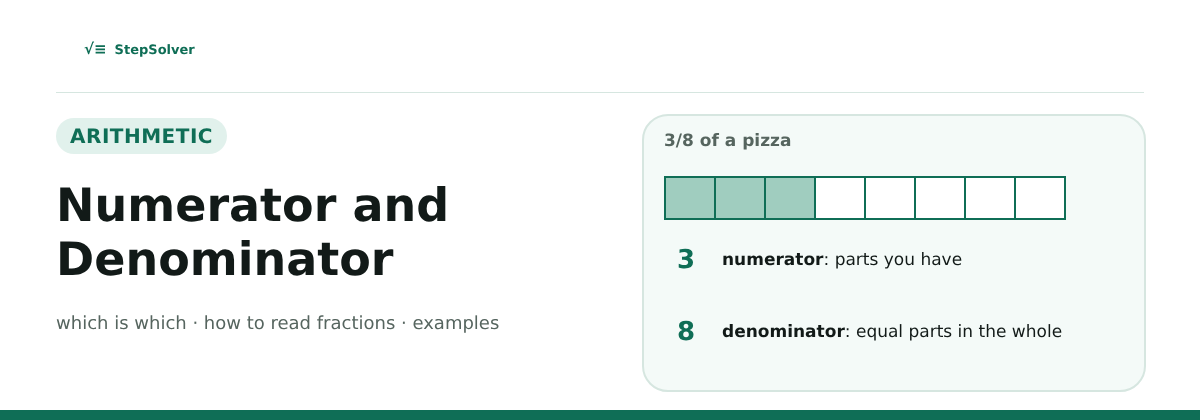
Every fraction has two numbers, and each one has a job. The numerator is the top number and counts the parts you have. The denominator is the bottom number and shows how many equal parts make up one whole. This guide explains both, shows how to read them, and covers what happens to each one when you compare, add or simplify fractions.
The Short Answer
In the fraction 3/8, the numerator is 3 and the denominator is 8. Picture a pizza cut into 8 equal slices. The denominator 8 says how many slices make the whole pizza, and the numerator 3 says you have 3 of them.
What Is a Numerator?
The numerator sits above the fraction bar. It counts how many parts of the whole you are talking about. If you eat 3 slices of a pizza cut into 8, the numerator is 3.
What Is a Denominator?
The denominator sits below the fraction bar. It tells you the size of each part by saying how many equal parts the whole is divided into. A pizza cut into 8 slices has a denominator of 8, and each slice is one eighth.
How to Remember Which Is Which
- Denominator starts with D, and it is Down at the bottom.
- Numerator is the Number of parts you have, and it is on top.
- Alphabetical order helps too: Numerator comes before Denominator, and top comes before bottom.
Examples
| Fraction | Numerator | Denominator | How to say it |
|---|---|---|---|
| 1/2 | 1 | 2 | one half |
| 3/4 | 3 | 4 | three quarters |
| 2/3 | 2 | 3 | two thirds |
| 5/8 | 5 | 8 | five eighths |
| 7/10 | 7 | 10 | seven tenths |
| 9/5 | 9 | 5 | nine fifths |
The numerator is read as a normal number, and the denominator is read as the name of the part: halves, thirds, quarters, fifths, and so on.
What Each Number Does to the Size of a Fraction
- Same denominator, bigger numerator: you have more pieces of the same size, so the fraction is larger. 5/8 is bigger than 3/8.
- Same numerator, bigger denominator: the pieces are smaller, so the fraction is smaller. 1/8 is smaller than 1/4, and 3/10 is smaller than 3/5.
This second rule surprises many students, because 8 is bigger than 4 but 1/8 is smaller than 1/4. Cutting a pizza into more slices makes every slice smaller.
Special Cases
- The denominator can never be 0. You cannot split something into zero equal parts, so 5/0 is undefined.
- The numerator can be 0. You have no parts, so 0/5 = 0.
- Equal numerator and denominator: you have the whole thing, so 4/4 = 1.
- Whole numbers: write them over 1. For 6, the numerator is 6 and the denominator is 1, because 6 = 6/1.
- Division: a fraction is also a division. The numerator is divided by the denominator, so 3/4 = 3 ÷ 4 = 0.75.
What Happens to Them in Each Operation
| Operation | Numerator | Denominator |
|---|---|---|
| Add or subtract (same denominator) | Add or subtract | Stays the same |
| Multiply | Multiply the numerators | Multiply the denominators |
| Simplify | Divide by the common factor | Divide by the same common factor |
| Find the reciprocal | Swap with the denominator | Swap with the numerator |
For the full steps, see our guides on adding, subtracting, multiplying and dividing fractions and simplifying fractions. For fraction types, see proper vs improper fractions vs mixed numbers.
Worked Examples
Example 1: name the parts
In 7/12, the numerator is 7 and the denominator is 12. The whole is split into 12 equal parts and you have 7 of them.
Example 2: write a fraction from a situation
A class has 20 students, and 8 of them are girls. What fraction of the class are girls?
- The whole is the whole class, so the denominator is 20.
- The part you want is the girls, so the numerator is 8.
- The fraction is 8/20. Divide both by 4 to simplify: 2/5.
Example 3: compare by looking at the denominator
Which is larger, 3/10 or 3/5?
- Both have the same numerator, 3.
- Tenths are smaller pieces than fifths, so 3 tenths is less than 3 fifths.
- Check with decimals: 3/10 = 0.3 and 3/5 = 0.6.
Common Mistakes to Avoid
- Mixing up the two. Top is the numerator, bottom is the denominator. Use the D for Down trick.
- Thinking a bigger denominator means a bigger fraction. It means smaller pieces.
- Adding denominators. 1/4 + 1/4 is 2/4, not 2/8. The denominator names the size of the piece, so it stays the same.
- Using a denominator of 0. A fraction with a zero denominator has no value.
- Using unequal parts. A fraction only works when the whole is divided into equal parts.
Practice Problems
- Name the numerator and denominator of 5/9.
- A pizza is cut into 12 slices and you eat 5. What fraction did you eat?
- Which is larger, 2/7 or 2/3?
- What are the numerator and denominator of 4?
- What is 0/9?
Answers
- Numerator 5, denominator 9.
- 5/12. The 12 slices are the denominator and the 5 you ate are the numerator.
- 2/3 is larger, because thirds are bigger pieces than sevenths.
- Numerator 4 and denominator 1, because 4 = 4/1.
- 0, because you have no parts out of 9.
Frequently Asked Questions
- Which number is the numerator and which is the denominator?
- The numerator is the top number and the denominator is the bottom number. In 3/8, the numerator is 3 and the denominator is 8.
- What does the numerator tell you?
- The numerator tells you how many parts you have. In 3/8 you have 3 parts.
- What does the denominator tell you?
- The denominator tells you how many equal parts make up one whole. In 3/8, the whole is split into 8 equal parts.
- How can you remember which is which?
- Denominator starts with D, and it sits Down at the bottom. The numerator is the other one, on top. Another trick: Numerator is the Number of parts you have.
- Can the denominator be zero?
- No. A fraction with a denominator of 0 is undefined, because you cannot split something into zero equal parts. The numerator, however, can be 0: 0/5 equals 0.
- Does a bigger denominator mean a bigger fraction?
- No, the opposite. A bigger denominator means the whole is cut into more pieces, so each piece is smaller. 1/8 is smaller than 1/4.
- What are the numerator and denominator of a whole number?
- Any whole number can be written over 1. For 6, the numerator is 6 and the denominator is 1, because 6 = 6/1.