
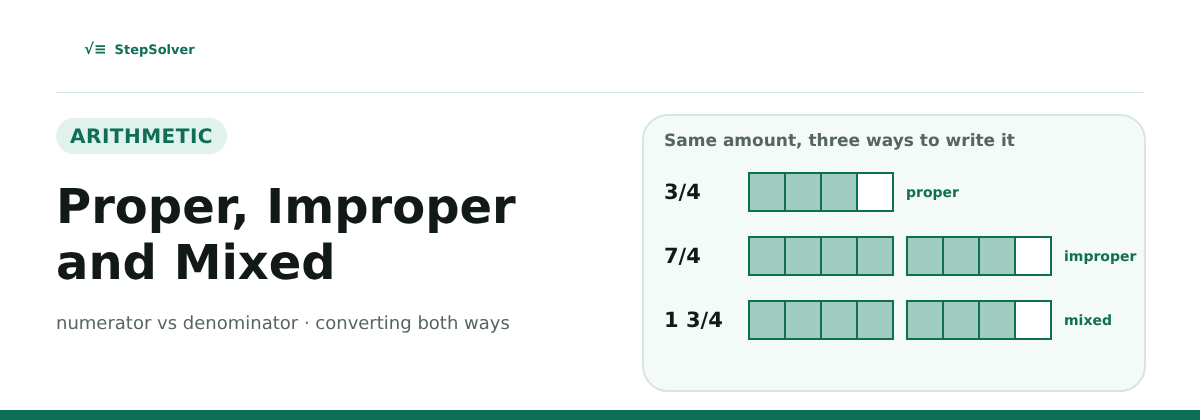
Fractions come in three forms, and the names are easy to mix up. A proper fraction is less than 1, an improper fraction is 1 or more, and a mixed number is a whole number with a fraction attached. This guide shows how to tell them apart, how to convert between them in both directions, and which form to use when.
The Three Types at a Glance
| Type | Rule | Examples | Value |
|---|---|---|---|
| Proper fraction | Numerator is smaller than the denominator | 1/2, 3/4, 5/9 | Less than 1 |
| Improper fraction | Numerator is equal to or larger than the denominator | 7/4, 9/5, 6/6 | 1 or more |
| Mixed number | A whole number plus a proper fraction | 1 3/4, 2 1/5, 4 2/3 | More than 1 |
Improper fractions and mixed numbers are two ways to write the same amount. 7/4 and 1 3/4 are equal: seven quarters is one whole and three more quarters.
Proper Fractions
In a proper fraction, the numerator (top number) is smaller than the denominator (bottom number). You have fewer pieces than it takes to make a whole, so the value is always between 0 and 1.
- 3/8 is three of eight equal pieces, which is less than one whole.
- As a decimal, a proper fraction is always below 1: 3/8 = 0.375.
- As a percent, it is always below 100%: 3/8 = 37.5%.
Improper Fractions
In an improper fraction, the numerator is equal to or larger than the denominator. You have at least one whole. The word "improper" only describes the shape of the fraction. It is not a mistake, and improper fractions are often the easiest form to calculate with.
- 9/5 means nine fifths, which is one whole (5/5) plus four more fifths.
- Any fraction with the same numerator and denominator equals exactly 1: 4/4 = 1, 9/9 = 1.
- As a decimal, an improper fraction is 1 or more: 9/5 = 1.8, or 180%.
Mixed Numbers
A mixed number writes the whole part and the fractional part side by side. In 2 1/5, the 2 is the whole number and 1/5 is a proper fraction. It means 2 + 1/5.
Mixed numbers are the natural form for everyday measurements: 1 1/2 cups of flour, 3 3/4 inches of board. They are easier to picture than 15/4.
How to Convert an Improper Fraction to a Mixed Number
Divide the numerator by the denominator. The quotient becomes the whole number, the remainder becomes the new numerator, and the denominator stays the same.
Example: convert 17/5
- Divide: 17 ÷ 5 = 3 with a remainder of 2.
- The whole number is 3.
- The remainder 2 goes over the original denominator 5.
Check: 3 whole units is 15/5, and 15/5 + 2/5 = 17/5.
How to Convert a Mixed Number to an Improper Fraction
Multiply the whole number by the denominator, add the numerator, and put the total over the same denominator.
Example: convert 3 4/7
- Multiply the whole number by the denominator: 3 × 7 = 21.
- Add the numerator: 21 + 4 = 25.
- Keep the denominator: 7.
Whole Numbers and Fractions
Every whole number is also a fraction. Write it over 1: 5 = 5/1. You can also write it with any denominator you need. To write 5 as a fraction with denominator 3, multiply 5 by 3 to get 15, so 5 = 15/3. This trick is useful when you subtract a fraction from a whole number, such as 3 minus 1/4, which becomes 12/4 minus 1/4 = 11/4.
Which Form Should You Use?
- Calculating: use improper fractions. Multiplying and dividing mixed numbers is much easier after converting them. See how to add, subtract, multiply and divide fractions.
- Final answers in everyday life: use a mixed number, because 2 3/4 is easier to picture than 11/4.
- Algebra and higher maths: improper fractions are usually preferred, and mixed numbers can be confused with multiplication (2 3/4 could be misread as 2 × 3/4).
- Always simplify. Reduce the fraction part to lowest terms. Our guide on how to simplify fractions shows three methods.
Where They Sit on a Number Line
A proper fraction sits between 0 and 1. An improper fraction or mixed number sits at 1 or beyond. 7/4 = 1 3/4 lies three quarters of the way from 1 to 2. Negative values work the same way: -7/3 = -2 1/3 sits between -3 and -2.
Common Mistakes to Avoid
- Calling 4/4 or 6/6 proper. If the numerator equals the denominator, it is improper and equals 1.
- Forgetting to keep the denominator. When converting 17/5, the answer is 3 2/5, not 3 2/17 or 3 2.
- Adding instead of multiplying. For 3 4/7, the numerator is 3 × 7 + 4 = 25, not 3 + 4 + 7.
- Reading a mixed number as multiplication. 2 1/2 means 2 + 1/2 = 2.5, not 2 × 1/2 = 1.
- Leaving the fraction part unsimplified. 3 6/8 should be written as 3 3/4.
Practice Problems
Try these first, then check the answers below.
- Convert 19/6 to a mixed number.
- Convert 4 3/5 to an improper fraction.
- Convert 31/8 to a mixed number.
- Convert 6 1/4 to an improper fraction.
- Is 8/8 proper or improper, and what is its value?
- Write 2 7/9 as an improper fraction.
Answers
- 19 ÷ 6 = 3 remainder 1, so 19/6 = 3 1/6.
- 4 × 5 + 3 = 23, so 4 3/5 = 23/5.
- 31 ÷ 8 = 3 remainder 7, so 31/8 = 3 7/8.
- 6 × 4 + 1 = 25, so 6 1/4 = 25/4.
- Improper, because the numerator equals the denominator. Its value is exactly 1.
- 2 × 9 + 7 = 25, so 2 7/9 = 25/9.
Frequently Asked Questions
- What is the difference between a proper and an improper fraction?
- In a proper fraction the numerator is smaller than the denominator, so the value is less than 1, such as 3/4. In an improper fraction the numerator is equal to or larger than the denominator, so the value is 1 or more, such as 7/4 or 5/5.
- Is an improper fraction wrong?
- No. Improper fractions are completely valid and are usually the best form for calculations. The word improper only describes the shape of the fraction, not a mistake.
- How do you change an improper fraction to a mixed number?
- Divide the numerator by the denominator. The quotient is the whole number, the remainder is the new numerator, and the denominator stays the same. For 17/5, 17 ÷ 5 = 3 remainder 2, so the mixed number is 3 2/5.
- How do you change a mixed number to an improper fraction?
- Multiply the whole number by the denominator, add the numerator, and place the result over the same denominator. For 3 4/7, 3 × 7 + 4 = 25, so the improper fraction is 25/7.
- Is a whole number a fraction?
- Yes. Any whole number can be written over 1, so 5 = 5/1. It can also be written with any denominator, for example 5 = 10/2 = 15/3.
- Is 1 an improper fraction?
- The number 1 is a whole number, but fractions such as 4/4 or 9/9 are improper fractions because the numerator equals the denominator, and each one equals 1.
- Which form should I use in my answer?
- Use the form your teacher or question asks for. As a general rule, use improper fractions while calculating and a mixed number for the final answer in everyday contexts such as recipes and measurements.