
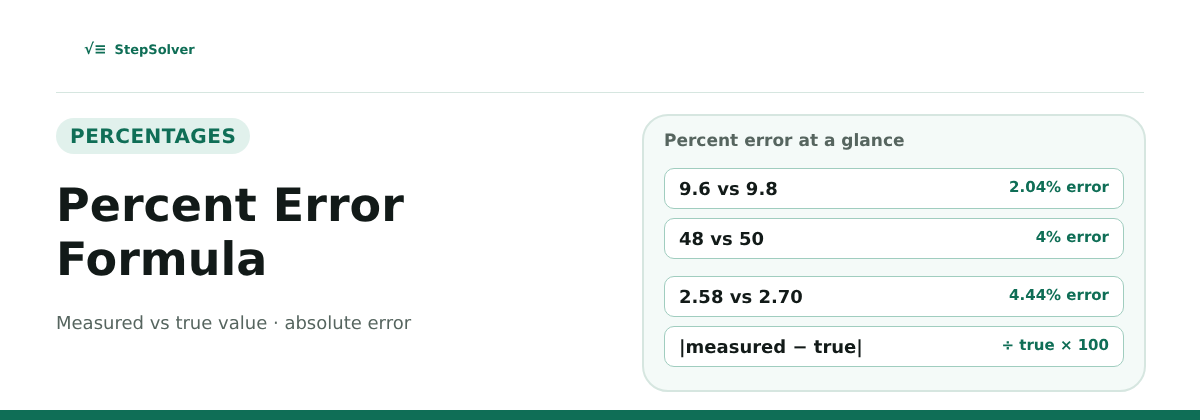
Percent error tells you how far a measured or estimated value is from the true value, as a percentage of the true value. It is used in science labs, engineering and statistics. This guide gives the formula, worked examples, how it differs from percent change, and the mistakes to avoid.
The Percent Error Formula
The true value is also called the accepted, actual or theoretical value. The vertical bars mean absolute value, so the result is never negative. Always divide by the true value, not by your measurement.
How to Calculate Percent Error
- Subtract the true value from the measured value.
- Take the absolute value to remove any minus sign.
- Divide by the true value.
- Multiply by 100 and add the % sign.
Worked Example 1: A Length Measurement
A student measures a length as 9.6 cm. The true length is 9.8 cm.
- 9.6 − 9.8 = −0.2, and the absolute value is 0.2.
- 0.2 ÷ 9.8 = 0.0204.
- 0.0204 × 100 = 2.04%.
Worked Example 2: Density of Aluminum
A lab measures the density of aluminum as 2.58 g/cm³. The accepted value is 2.70 g/cm³.
- |2.58 − 2.70| = 0.12.
- 0.12 ÷ 2.70 = 0.0444.
- 0.0444 × 100 = 4.44%.
Worked Example 3: A Prediction
A forecast says 50 people will attend an event, and 48 actually come. The true value is 48, because the actual count is the real result.
Here the estimate is 50, the true value is 48, so the percent error is |50 − 48| ÷ 48 × 100 = 2 ÷ 48 × 100 = 4.17%.
The role of each number matters. In a lab, the true value is the accepted figure. In a forecast, the true value is what actually happened.
Signed vs Absolute Percent Error
Most textbooks use the absolute value, so percent error is always positive. Some fields keep the sign to show direction: (Measured − True) ÷ True × 100. In Example 1 the signed error is −2.04%, which shows the measurement was too low. Use the version your teacher or course asks for.
Percent Error vs Percent Difference vs Percent Change
| Measure | Use it when | Divide by |
|---|---|---|
| Percent error | You compare a measured value with a known true value | The true value |
| Percent change | A value moves from an old amount to a new one | The original value |
| Percent difference | You compare two values and neither is the reference | Their average |
Finding the Range of Acceptable Values
If the true value is 80 and the allowed error is 5%, the measured value can be between 80 × 0.95 and 80 × 1.05.
Common Mistakes to Avoid
- Dividing by the measured value. Divide by the true value.
- Swapping the two values. The true value goes in the denominator, even if the subtraction order does not matter once you take the absolute value.
- Forgetting to multiply by 100. 0.0204 is a decimal, not a percentage.
- Rounding too early. Keep extra digits until the final step.
- Using percent error when there is no true value. Use percent difference instead.
Practice Problems
- A scale reads 52 g for an object that is truly 50 g. Find the percent error.
- A measured length is 19.5 cm and the true length is 20 cm. Find the percent error.
- A student uses 3.14 for pi (3.14159). Find the percent error to 2 decimal places.
- A thermometer reads 98.5 °C in boiling water. The true value is 100 °C. Find the percent error.
- A true value is 200 and a measurement is 205. Find the percent error.
Answers
- |52 − 50| ÷ 50 × 100 = 4%.
- 0.5 ÷ 20 × 100 = 2.5%.
- 0.00159 ÷ 3.14159 × 100 = 0.05%.
- 1.5 ÷ 100 × 100 = 1.5%.
- 5 ÷ 200 × 100 = 2.5%.
Frequently Asked Questions
- What is the formula for percent error?
- Percent error = |Measured − True| ÷ True × 100. The true value is the accepted or actual value.
- What is a good percent error?
- It depends on the field. In school labs under 5% is often acceptable, while precision engineering may require well under 1%. Your instructor or standard sets the limit.
- Can percent error be negative?
- With the absolute value formula it cannot. Some fields keep the sign to show whether the measurement was too high or too low.
- What is the difference between percent error and percent difference?
- Percent error compares a measurement with a known true value and divides by it. Percent difference compares two values when neither is the reference and divides by their average.
- Do I divide by the measured value or the true value?
- Divide by the true value, also called the accepted or theoretical value.
- Why is my percent error over 100%?
- It happens when the measurement is more than double the true value or negative. Check for a unit mix-up or a data entry mistake.
- Is percent error the same as relative error?
- Relative error is |Measured − True| ÷ True as a decimal. Percent error is the same number multiplied by 100.