
Percentage increase and decrease tell you how much a number grew or shrank compared with where it started. The idea is simple: find the change, divide by the original value, then multiply by 100. This guide gives the formula, worked examples, and the traps that catch most people, such as successive changes and percentage points.
The Percentage Change Formula
A positive answer is a percentage increase. A negative answer is a percentage decrease. Always divide by the original (starting) value, never the new one.
How to Calculate Percentage Increase
- Subtract the original value from the new value.
- Divide the result by the original value.
- Multiply by 100 and add the % sign.
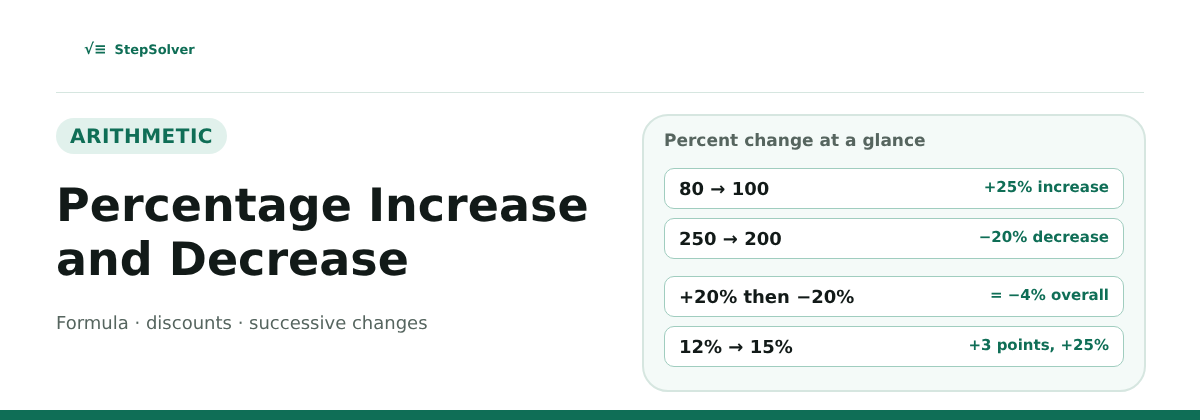
Example: a price rises from 80 to 100.
- 100 − 80 = 20.
- 20 ÷ 80 = 0.25.
- 0.25 × 100 = 25%.
How to Calculate Percentage Decrease
Use the same formula. The change will be negative, which shows a decrease.
Example: a price falls from 250 to 200.
- 200 − 250 = −50.
- −50 ÷ 250 = −0.2.
- −0.2 × 100 = −20%.
Quick Reference: Multipliers
A faster way to apply a percentage change is to multiply by a growth factor.
| Change | Multiply by |
|---|---|
| Increase by 10% | 1.10 |
| Increase by 25% | 1.25 |
| Decrease by 10% | 0.90 |
| Decrease by 20% | 0.80 |
| Decrease by 35% | 0.65 |
The rule is 1 + rate for an increase and 1 − rate for a decrease, with the rate written as a decimal.
Discount and Sales Tax Example
A jacket costs 60 and is 15% off. Sales tax of 8% is then added to the sale price.
- Sale price = 60 × 0.85 = 51.
- Price with tax = 51 × 1.08 = 55.08.
Why +20% and −20% Do Not Cancel Out
Each change is calculated on a different base. Start with 100, increase by 20% to get 120, then decrease by 20% of 120, which is 24, to get 96.
With multipliers: 1.20 × 0.80 = 0.96, so the overall result is a 4% decrease. To combine successive changes, multiply their factors rather than adding the percentages.
Finding the Original Value (Reverse Percentage)
If you know the final value after a percentage change, divide by the multiplier.
Example: after a 15% increase, a price is 115. What was the original?
- Multiplier = 1.15.
- Original = 115 ÷ 1.15 = 100.
A common mistake is to subtract 15% from 115. That gives 97.75, which is wrong because the 15% was calculated on the original, not on 115.
Percentage Points vs Percent
When a rate that is already a percentage changes, there are two different ways to describe it.
Example: an interest rate goes from 12% to 15%.
- Percentage points: 15 − 12 = 3 percentage points.
- Percent change: 3 ÷ 12 × 100 = 25% increase.
Both are correct, but they mean different things, so say which one you are reporting.
Real-Life Examples
| Situation | Calculation | Result |
|---|---|---|
| Population grows from 12,500 to 13,750 | 1,250 ÷ 12,500 × 100 | 10% increase |
| Salary rises from 4,000 to 4,300 | 300 ÷ 4,000 × 100 | 7.5% increase |
| Stock falls from 50 to 45 | −5 ÷ 50 × 100 | 10% decrease |
Common Mistakes to Avoid
- Dividing by the new value. Always divide by the original.
- Adding successive percentages. A 10% rise followed by another 10% rise is 21% overall, not 20%.
- Undoing a percentage by subtracting the same percentage. Divide by the multiplier instead.
- Mixing up percent and percentage points.
- Forgetting the sign. A negative result means a decrease, so do not also write "decrease" with a minus sign in the same sentence.
Practice Problems
- Find the percent change from 40 to 52.
- Find the percent change from 90 to 72.
- A salary of 150 rises by 12%. What is the new salary?
- An item priced at 200 is reduced by 35%. What is the sale price?
- Two successive 10% increases are applied. What is the overall percentage increase?
Answers
- (52 − 40) ÷ 40 × 100 = 30% increase.
- (72 − 90) ÷ 90 × 100 = −20%, a 20% decrease.
- 150 × 1.12 = 168.
- 200 × 0.65 = 130.
- 1.10 × 1.10 = 1.21, so a 21% increase.
Frequently Asked Questions
- What is the formula for percentage increase?
- Percentage increase = (New value − Original value) ÷ Original value × 100. A positive result is an increase.
- What is the formula for percentage decrease?
- Use the same formula, (New − Original) ÷ Original × 100. A negative result means a decrease, and you can drop the minus sign when you write it as a decrease.
- Why do you divide by the original value?
- The percentage describes the change relative to where you started, so the starting value is the base. Dividing by the new value gives a different, incorrect answer.
- Why does a 20% increase followed by a 20% decrease not return to the start?
- The second change is calculated on the larger number. 100 becomes 120, and 20% of 120 is 24, giving 96. Overall the value is 4% lower.
- How do I add or subtract a percentage quickly?
- Multiply by a factor. For a 15% increase multiply by 1.15, and for a 15% decrease multiply by 0.85.
- How do I find the original price before a discount?
- Divide the sale price by the multiplier. If a 20% discount gives 80, the original price is 80 ÷ 0.80 = 100.
- What is the difference between percent and percentage points?
- Percentage points are the simple difference between two percentages. Percent change compares that difference with the starting percentage. Going from 12% to 15% is 3 percentage points, or a 25% increase.