
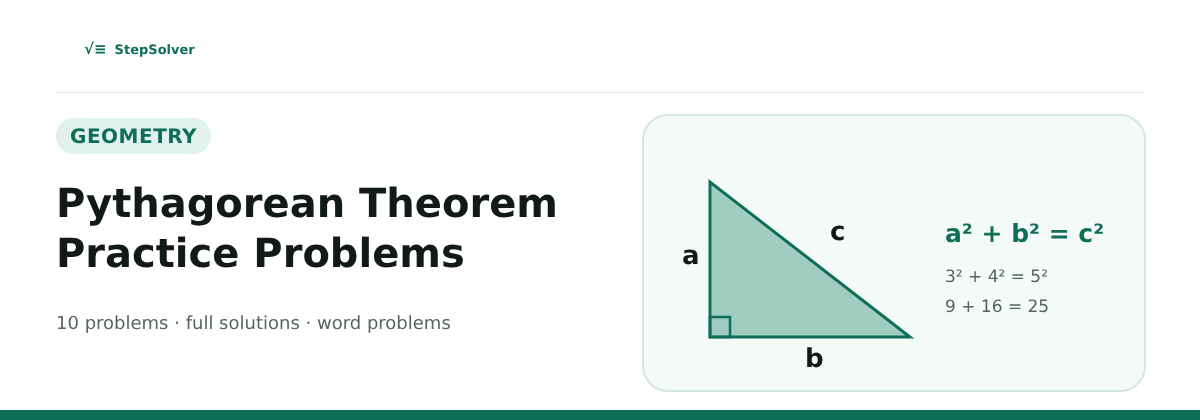
The best way to learn the Pythagorean theorem is to use it. This page has 10 practice problems with step-by-step solutions: finding the hypotenuse, finding a missing leg, testing for a right triangle, and two real-life word problems. Try each one on paper first, then compare with the solution.
The Theorem in One Line
In a right triangle, a and b are the two shorter sides (the legs) and c is the hypotenuse, the longest side, opposite the right angle. The theorem only works for right triangles.
| You know | You want | Formula |
|---|---|---|
| Both legs a and b | Hypotenuse c | c = √(a² + b²) |
| Hypotenuse c and leg a | Other leg b | b = √(c² − a²) |
| All three sides | Is it a right triangle? | Check a² + b² = c² |
Common Pythagorean Triples
A Pythagorean triple is a set of three whole numbers that fit the theorem. Knowing a few saves time, and any multiple of a triple also works.
| Triple | Check | Multiples |
|---|---|---|
| 3, 4, 5 | 9 + 16 = 25 | 6, 8, 10 and 9, 12, 15 |
| 5, 12, 13 | 25 + 144 = 169 | 10, 24, 26 |
| 8, 15, 17 | 64 + 225 = 289 | 16, 30, 34 |
| 7, 24, 25 | 49 + 576 = 625 | 14, 48, 50 |
| 20, 21, 29 | 400 + 441 = 841 | 40, 42, 58 |
Set 1: Find the Hypotenuse
When you know both legs a and b, add their squares and take the square root: c = √(a² + b²).
Problem 1: Legs 3 and 4
Find c, a whole-number answer
- Square each leg: 3² = 9 and 4² = 16.
- Add: 9 + 16 = 25.
- Take the square root: √25 = 5.
Problem 2: Legs 5 and 12
Find c, another Pythagorean triple
- 5² = 25 and 12² = 144.
- Add: 25 + 144 = 169.
- √169 = 13.
Problem 3: Legs 7 and 9
Find c, answer is not a whole number
- 7² = 49 and 9² = 81.
- Add: 49 + 81 = 130.
- c = √130, which is about 11.40.
Set 2: Find a Missing Leg
When you know the hypotenuse and one leg, subtract: b = √(c² − a²). The hypotenuse is always the longest side and is opposite the right angle.
Problem 4: Hypotenuse 10 and one leg 6
Find the missing leg
- Square each: 10² = 100 and 6² = 36.
- Subtract: 100 − 36 = 64.
- √64 = 8.
Check: 6² + 8² = 36 + 64 = 100 = 10².
Problem 5: Hypotenuse 17 and one leg 8
Find the missing leg
- 17² = 289 and 8² = 64.
- Subtract: 289 − 64 = 225.
- √225 = 15.
Check: 8² + 15² = 64 + 225 = 289 = 17².
Problem 6: Hypotenuse 13 and one leg 6
Missing leg, answer is not a whole number
- 13² = 169 and 6² = 36.
- Subtract: 169 − 36 = 133.
- b = √133, which is about 11.53.
Set 3: Is It a Right Triangle?
The converse of the theorem says that if a² + b² = c² for the three sides, with c the longest, the triangle has a right angle. If a² + b² is greater than c², the triangle is acute. If it is less, the triangle is obtuse.
Problem 7: Sides 8, 15 and 17
Test for a right triangle
- The longest side is 17, so test 8² + 15² against 17².
- 8² + 15² = 64 + 225 = 289.
- 17² = 289, and the two sides are equal.
Problem 8: Sides 6, 7 and 9
Test for a right triangle
- The longest side is 9, so test 6² + 7² against 9².
- 6² + 7² = 36 + 49 = 85.
- 9² = 81. Since 85 is not equal to 81, it is not a right triangle.
- Because 85 is greater than 81, the triangle is acute.
Set 4: Word Problems
Problem 9: A 13 ft ladder leans against a wall with its base 5 ft from the wall. How high up the wall does it reach?
Ladder problem
- The ladder is the hypotenuse, so c = 13. The base distance is one leg, so a = 5.
- Find the other leg: b² = 13² − 5² = 169 − 25 = 144.
- b = √144 = 12.
Check: 5² + 12² = 25 + 144 = 169 = 13².
Problem 10: A TV screen is 48 inches wide and 27 inches tall. What is the diagonal size?
Diagonal of a rectangle
- The diagonal is the hypotenuse of a right triangle with legs 48 and 27.
- 48² = 2304 and 27² = 729.
- Add: 2304 + 729 = 3033.
- c = √3033, which is about 55.07.
Common Mistakes to Avoid
- Mixing up the hypotenuse. The hypotenuse is always the longest side. It is c, and it goes on its own side of the equation.
- Adding when you should subtract. To find a leg, subtract: c² − a². Adding gives a wrong answer larger than c.
- Forgetting the square root. After adding or subtracting the squares, you have c², not c. Take the square root at the end.
- Squaring the sum. (a + b)² is not a² + b². Square each side first, then add.
- Using the theorem on any triangle. It only applies when one angle is exactly 90 degrees.
- Rounding too early. Keep the full square root until the last step, then round the final answer.
Practice Problems for You
Now try these on your own. Answers are below.
- Find the hypotenuse of a right triangle with legs 8 and 6.
- Find the missing leg when the hypotenuse is 25 and one leg is 7.
- Do the sides 9, 12 and 15 make a right triangle?
- A 10 ft ladder has its base 6 ft from a wall. How high does it reach?
- Find the diagonal of a rectangle that is 9 m by 12 m.
Answers
- √(64 + 36) = √100 = 10.
- √(625 − 49) = √576 = 24.
- 9² + 12² = 81 + 144 = 225 = 15², so yes.
- √(100 − 36) = √64 = 8 ft.
- √(81 + 144) = √225 = 15 m.
Frequently Asked Questions
- What is the Pythagorean theorem?
- In a right triangle, the square of the hypotenuse equals the sum of the squares of the other two sides: a² + b² = c². The hypotenuse c is the longest side, opposite the right angle.
- How do you find the hypotenuse?
- Square both legs, add the results and take the square root. For legs 3 and 4: 9 + 16 = 25, and √25 = 5.
- How do you find a missing leg?
- Subtract the square of the known leg from the square of the hypotenuse, then take the square root. With hypotenuse 10 and one leg 6: 100 − 36 = 64, and √64 = 8.
- Does the Pythagorean theorem work for any triangle?
- No. It works only for right triangles, which have one angle of exactly 90 degrees. For other triangles you need the law of cosines.
- How do you test whether a triangle is a right triangle?
- Square the two shorter sides and add them. If the sum equals the square of the longest side, it is a right triangle. If the sum is greater, the triangle is acute. If it is smaller, the triangle is obtuse.
- What is a Pythagorean triple?
- A Pythagorean triple is a set of three whole numbers that satisfy a² + b² = c², such as 3, 4, 5 and 5, 12, 13. Any whole-number multiple of a triple, like 6, 8, 10, is also a triple.
- Can the sides of a right triangle be decimals?
- Yes. The theorem works for any positive lengths. Many answers are not whole numbers, such as √130, which is about 11.40.