
The best way to learn quadratic equations is to solve them. This page has 10 practice problems with full step-by-step solutions, ordered from easy factoring to the quadratic formula, complex roots and a real-world word problem. Try each one on paper first, then compare your working with the solution.
Quick Reference Before You Start
A quadratic equation in standard form looks like ax² + bx + c = 0, where a is not zero. Check which method fits:
| Method | Use it when |
|---|---|
| Factoring | The numbers are small and two factors of c add to b |
| Square roots | There is no x term, such as x² = 49 |
| Quadratic formula | Factoring is not obvious, or the answers are not whole numbers |
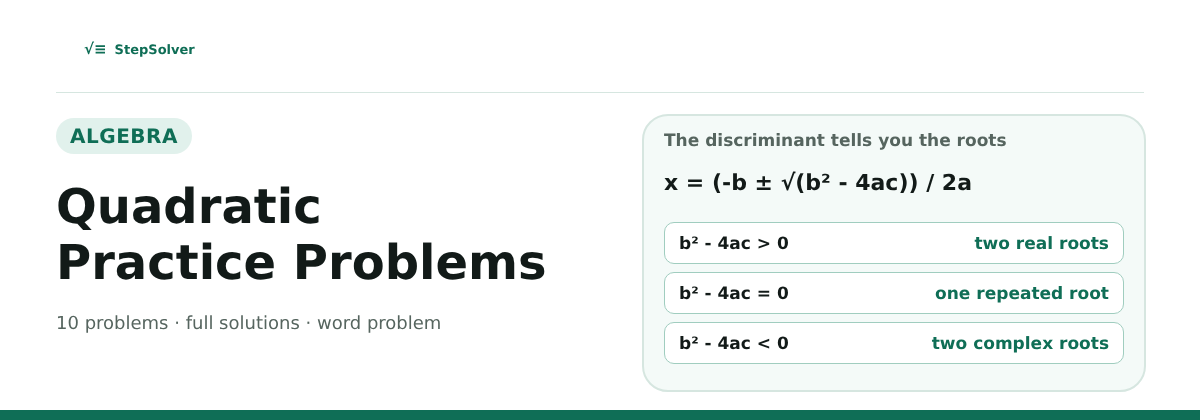
The discriminant b² − 4ac tells you what to expect before you solve: positive means two real solutions, zero means one repeated solution, and negative means two complex solutions. For a longer explanation, see our Quadratic Formula Calculator, which shows the discriminant and every step.
Set 1: Solve by Factoring
When the numbers are friendly, factoring is the quickest method. Find two numbers that multiply to c and add to b.
Problem 1: x² − 5x + 6 = 0
Factoring, a = 1
- Find two numbers that multiply to 6 and add to −5. They are −2 and −3.
- Factor: (x − 2)(x − 3) = 0.
- Set each factor to zero: x − 2 = 0 or x − 3 = 0.
Check: 2² − 5(2) + 6 = 4 − 10 + 6 = 0, and 3² − 5(3) + 6 = 9 − 15 + 6 = 0.
Problem 2: x² + 2x − 15 = 0
Factoring, negative constant
- Find two numbers that multiply to −15 and add to 2. They are 5 and −3.
- Factor: (x + 5)(x − 3) = 0.
- Set each factor to zero: x = −5 or x = 3.
Check: (−5)² + 2(−5) − 15 = 25 − 10 − 15 = 0.
Problem 3: 2x² − 7x + 3 = 0
Factoring, a is not 1
- Multiply a and c: 2 × 3 = 6. Find two numbers that multiply to 6 and add to −7. They are −6 and −1.
- Split the middle term: 2x² − 6x − x + 3 = 0.
- Group: 2x(x − 3) − 1(x − 3) = 0, so (2x − 1)(x − 3) = 0.
- Set each factor to zero: 2x − 1 = 0 gives x = 1/2, and x − 3 = 0 gives x = 3.
Check: 2(1/2)² − 7(1/2) + 3 = 0.5 − 3.5 + 3 = 0.
Set 2: Special Cases
Problem 4: x² − 49 = 0
Difference of two squares, no x term
- Move the number: x² = 49.
- Take the square root of both sides, keeping both signs: x = ±√49.
Problem 5: x² + 6x + 9 = 0
Perfect square trinomial
- Recognise the pattern: x² + 6x + 9 = (x + 3)².
- So (x + 3)² = 0, which means x + 3 = 0.
Check: The discriminant is 6² − 4(1)(9) = 36 − 36 = 0, which confirms there is only one solution.
Set 3: The Quadratic Formula
When factoring is not obvious, use the quadratic formula. For ax² + bx + c = 0:
Problem 6: x² − 4x + 1 = 0
Quadratic formula, irrational roots
- Identify a = 1, b = −4, c = 1.
- Discriminant: b² − 4ac = 16 − 4 = 12.
- Substitute: x = (4 ± √12) / 2.
- Simplify √12 = 2√3, so x = (4 ± 2√3) / 2 = 2 ± √3.
Problem 7: 3x² + 2x − 1 = 0
Quadratic formula, a is not 1
- Identify a = 3, b = 2, c = −1.
- Discriminant: b² − 4ac = 4 − 4(3)(−1) = 4 + 12 = 16.
- Substitute: x = (−2 ± √16) / 6 = (−2 ± 4) / 6.
- Two solutions: x = (−2 + 4)/6 = 1/3 and x = (−2 − 4)/6 = −1.
Check: 3(1/3)² + 2(1/3) − 1 = 1/3 + 2/3 − 1 = 0.
Problem 8: x² + 4x + 5 = 0
Negative discriminant, complex roots
- Identify a = 1, b = 4, c = 5.
- Discriminant: b² − 4ac = 16 − 20 = −4.
- A negative discriminant means no real solutions. Use √−4 = 2i.
- Substitute: x = (−4 ± 2i) / 2 = −2 ± i.
Set 4: Rearranging and Word Problems
Problem 9: 2x² − 4x = 6
Rearrange to standard form first
- Move everything to one side: 2x² − 4x − 6 = 0.
- Divide every term by 2: x² − 2x − 3 = 0.
- Factor: (x − 3)(x + 1) = 0.
- Set each factor to zero: x = 3 or x = −1.
Check: 2(3)² − 4(3) = 18 − 12 = 6, and 2(−1)² − 4(−1) = 2 + 4 = 6.
Problem 10: A ball is thrown upward. Its height is h = −5t² + 20t + 25 metres after t seconds. When does it hit the ground?
Word problem
- The ball is on the ground when h = 0: −5t² + 20t + 25 = 0.
- Divide by −5: t² − 4t − 5 = 0.
- Factor: (t − 5)(t + 1) = 0, so t = 5 or t = −1.
- Time cannot be negative, so reject t = −1.
Check: −5(25) + 20(5) + 25 = −125 + 100 + 25 = 0.
Which Method Should You Use?
- First, rearrange. Always get the equation into ax² + bx + c = 0 before choosing a method (Problem 9).
- Missing x term? Use square roots (Problem 4).
- Small whole numbers? Try factoring (Problems 1 to 3).
- Not sure, or messy numbers? Use the quadratic formula (Problems 6 to 8). It always works.
- Calculate the discriminant first if you only need to know how many real solutions there are.
Common Mistakes to Avoid
- Forgetting the ± sign. A quadratic usually has two solutions, so take both the plus and minus branches.
- Sign errors with b. In x² − 4x + 1 = 0, b is −4, so −b is 4, not −4.
- Not setting the equation to zero. You cannot factor 2x² − 4x = 6 directly. Move the 6 across first.
- Dividing by x. Never divide both sides by x, because you lose the solution x = 0.
- Keeping impossible answers. In word problems, reject negative times or lengths, as in Problem 10.
- Skipping the check. Substituting your answers back takes a few seconds and catches most errors.
Frequently Asked Questions
- What is the easiest way to solve a quadratic equation?
- Start by checking whether it factors. If it does, factoring is the fastest method. If it does not factor neatly, or you are unsure, the quadratic formula always works for any quadratic equation.
- What does the discriminant tell you?
- The discriminant is b² − 4ac. If it is positive, there are two different real solutions. If it is zero, there is one repeated real solution. If it is negative, there are no real solutions, only two complex ones.
- Can a quadratic equation have no solution?
- It has no real solution when the discriminant is negative, because you cannot take the square root of a negative number in the real numbers. It still has two complex solutions, such as −2 + i and −2 − i.
- Why must the equation equal zero before using the formula?
- The formula and the factoring method both rely on the standard form ax² + bx + c = 0. If the equation is not in that form, move every term to one side first.
- What if a is negative?
- The formula works exactly the same. You can also multiply the whole equation by −1 to make a positive, which gives the same solutions and often makes factoring easier.
- How do you check a quadratic equation answer?
- Substitute each solution back into the original equation. If both sides are equal, the solution is correct. For x² − 5x + 6 = 0, x = 2 gives 4 − 10 + 6 = 0.