
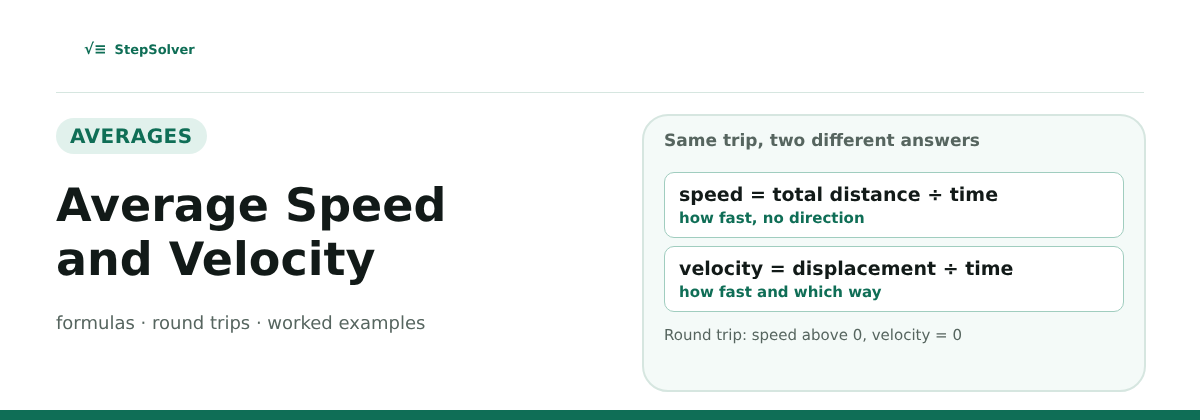
Average speed and average velocity sound alike, but they answer different questions. Average speed is total distance divided by total time. Average velocity is displacement divided by time. This guide gives both formulas, works through examples including round trips and unit conversion, and ends with practice problems.
The Formulas
Distance is the full length of the path you travelled. Displacement is the straight-line change in position from start to finish, with a direction. Speed has only a size. Velocity has a size and a direction.
| Average speed | Average velocity | |
|---|---|---|
| Uses | Total distance | Displacement |
| Has direction? | No | Yes |
| Can it be zero? | Only if you did not move | Yes, if you end where you started |
| Can it be negative? | No | Yes, for motion in the negative direction |
| Common units | km/h, mph, m/s | km/h, mph, m/s, with a direction |
How to Calculate Average Speed
Example 1: one steady trip
A train travels 150 km in 3 hours. What is its average speed?
- Total distance = 150 km.
- Total time = 3 h.
- Average speed = 150 ÷ 3 = 50 km/h.
Example 2: a trip in two parts
A driver covers 60 km at 30 km/h, then another 60 km at 60 km/h. What is the average speed for the whole trip?
- Time for part 1: 60 ÷ 30 = 2 h.
- Time for part 2: 60 ÷ 60 = 1 h.
- Total distance = 60 + 60 = 120 km, and total time = 2 + 1 = 3 h.
- Average speed = 120 ÷ 3 = 40 km/h.
Notice that this is not (30 + 60) ÷ 2 = 45 km/h. The driver spent more time at the slower speed, so the true average is lower.
A shortcut for equal distances
When you cover equal distances at speeds v₁ and v₂, the average speed is 2 × v₁ × v₂ ÷ (v₁ + v₂). For 30 and 60 km/h: 2 × 30 × 60 ÷ 90 = 3600 ÷ 90 = 40 km/h, matching the answer above.
How to Calculate Average Velocity
Example 3: straight-line motion
A cyclist moves from the 5 m mark to the 35 m mark in 6 seconds. What is the average velocity?
- Displacement = 35 − 5 = 30 m in the positive direction.
- Average velocity = 30 ÷ 6 = 5 m/s.
If the cyclist had gone from 35 m back to 5 m in the same time, the displacement would be −30 m and the average velocity −5 m/s. The negative sign shows the direction.
Example 4: a path with a turn
A person walks 3 km east, then 4 km north, taking 2 hours in total. Find the average speed and average velocity.
- Total distance = 3 + 4 = 7 km, so average speed = 7 ÷ 2 = 3.5 km/h.
- Displacement is the straight line from start to finish. By the Pythagorean theorem: √(3² + 4²) = √25 = 5 km.
- Average velocity = 5 ÷ 2 = 2.5 km/h.
- The direction is about 53° north of east, because tan⁻¹(4 ÷ 3) is about 53.1°.
To find the straight-line distance for your own numbers, use the Pythagorean Theorem Calculator or try the Pythagorean theorem practice problems.
Example 5: a round trip
A runner goes 5 km out and 5 km back in 1 hour. Find the average speed and velocity.
- Total distance = 10 km, so average speed = 10 ÷ 1 = 10 km/h.
- The runner ends where they started, so displacement = 0 and average velocity = 0 ÷ 1 = 0 km/h.
Average Velocity With Constant Acceleration
When acceleration is constant, the average velocity is the mean of the starting and final velocity.
Example 6
A car speeds up steadily from 10 m/s to 30 m/s over 5 seconds. How far does it travel?
- Average velocity = (10 + 30) ÷ 2 = 20 m/s.
- Distance = average velocity × time = 20 × 5 = 100 m.
This shortcut only works when the acceleration is constant. For everything else, go back to displacement ÷ time.
Finding Distance or Time From Average Speed
Rearrange the formula to find the other quantity:
- Distance = speed × time. At 55 mph for 2.5 hours: 55 × 2.5 = 137.5 miles.
- Time = distance ÷ speed. To travel 300 km at 60 km/h: 300 ÷ 60 = 5 hours.
Make sure the time and speed use matching units. For 36 km in 45 minutes, convert 45 minutes to 0.75 hours first: 36 ÷ 0.75 = 48 km/h.
Unit Conversions
| To convert | Do this | Example |
|---|---|---|
| km/h to m/s | Divide by 3.6 | 72 km/h = 20 m/s |
| m/s to km/h | Multiply by 3.6 | 25 m/s = 90 km/h |
| Minutes to hours | Divide by 60 | 45 min = 0.75 h |
| Hours to seconds | Multiply by 3600 | 2 h = 7200 s |
Common Mistakes to Avoid
- Averaging the speeds. Never add two speeds and halve them unless the times are equal. Use total distance ÷ total time.
- Using distance when you need displacement. Velocity uses the straight-line change in position, not the path length.
- Ignoring direction. Velocity needs a direction, and a return trip can cancel the displacement.
- Mixing units. Do not divide kilometres by minutes and call it km/h. Convert first.
- Using (v₀ + v) ÷ 2 when acceleration is not constant. It only holds for steady acceleration.
Practice Problems
- A bus travels 240 km in 4 hours. What is its average speed?
- A cyclist rides 9 miles in 45 minutes. What is the average speed in mph?
- A driver covers 100 km at 50 km/h, then 100 km at 100 km/h. What is the average speed?
- A runner completes one 400 m lap of a track in 80 seconds. Find the average speed and average velocity.
- A hiker walks 6 km west, then 8 km north, in 2 hours. Find the average speed and the size of the average velocity.
- Convert 90 km/h to m/s.
Answers
- 240 ÷ 4 = 60 km/h.
- 45 minutes = 0.75 h, so 9 ÷ 0.75 = 12 mph.
- Times are 2 h and 1 h, so 200 ÷ 3 = about 66.7 km/h (not 75).
- Average speed = 400 ÷ 80 = 5 m/s. The runner ends where they started, so displacement is 0 and average velocity is 0.
- Speed = 14 ÷ 2 = 7 km/h. Displacement = √(6² + 8²) = 10 km, so velocity = 10 ÷ 2 = 5 km/h.
- 90 ÷ 3.6 = 25 m/s.
Frequently Asked Questions
- What is the formula for average speed?
- Average speed = total distance ÷ total time. If you travel 150 km in 3 hours, your average speed is 150 ÷ 3 = 50 km/h.
- What is the formula for average velocity?
- Average velocity = displacement ÷ time taken, where displacement is the straight-line change in position from start to finish, with direction. If you end up 5 km from where you began after 2 hours, your average velocity is 2.5 km/h in that direction.
- What is the difference between average speed and average velocity?
- Speed uses the total distance travelled and has no direction. Velocity uses displacement, the straight-line change in position, and includes direction. They are equal only when you travel in a straight line without turning back.
- Can average velocity be zero while average speed is not?
- Yes. If you finish where you started, your displacement is zero, so your average velocity is zero. Your average speed is still above zero because you covered some distance.
- Is average speed the same as the average of two speeds?
- Not usually. If you cover equal distances at two different speeds, the average speed is lower than the simple average of the speeds, because you spend more time at the slower speed. Always divide total distance by total time.
- How do you convert km/h to m/s?
- Multiply by 1000 and divide by 3600, which is the same as dividing by 3.6. So 72 km/h = 72 ÷ 3.6 = 20 m/s. To go from m/s to km/h, multiply by 3.6.
- How do you find average velocity with constant acceleration?
- Add the starting and final velocity and divide by 2. For a start of 10 m/s and an end of 30 m/s, the average velocity is (10 + 30) ÷ 2 = 20 m/s. This shortcut works only when the acceleration is constant.