
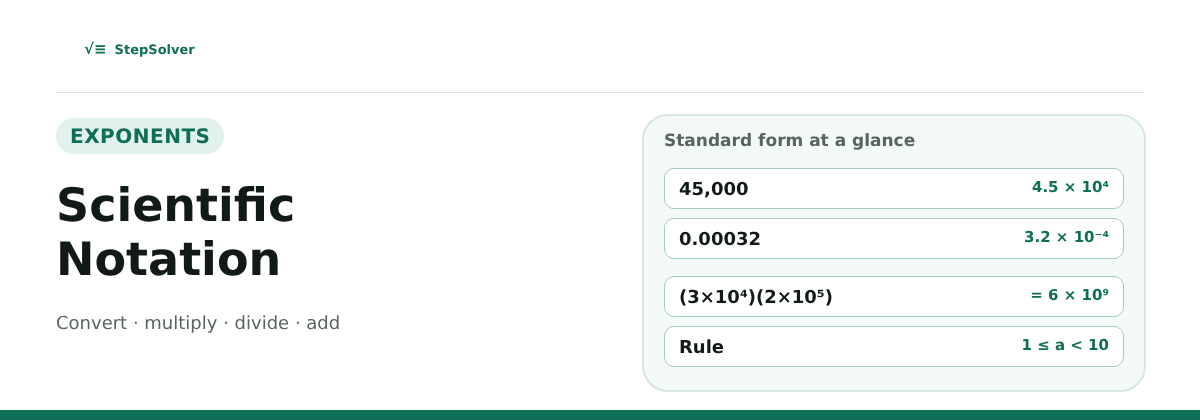
Scientific notation is a short way to write very large or very small numbers as a number between 1 and 10 multiplied by a power of 10. It is used in science, engineering and everyday calculators. This guide shows how to write it, convert it back, and add, subtract, multiply and divide with it.
What Is Scientific Notation?
The number a is called the coefficient (or mantissa). The exponent n says how many places the decimal point moved. A positive exponent means a large number, and a negative exponent means a number smaller than 1.
How to Write a Number in Scientific Notation
- Move the decimal point until there is exactly one non-zero digit to its left.
- Count how many places you moved it. That count is the exponent.
- If you moved the point left, the exponent is positive. If you moved it right, the exponent is negative.
Example 1: A Large Number
Write 45,000 in scientific notation. Move the decimal point 4 places left to get 4.5.
Example 2: A Small Number
Write 0.00032 in scientific notation. Move the decimal point 4 places right to get 3.2.
How to Convert Back to Standard Form
Move the decimal point the number of places shown by the exponent. Move right for a positive exponent and left for a negative one, adding zeros as needed.
- 7.2 × 103 = 7,200
- 5 × 10−3 = 0.005
Multiplying in Scientific Notation
Multiply the coefficients and add the exponents.
Example: (3 × 10⁴)(2 × 10⁵) = (3 × 2) × 104+5 = 6 × 10⁹.
If the coefficient ends up as 10 or more, adjust it. (4 × 10³)(5 × 10⁶) = 20 × 109, which becomes 2 × 10¹⁰.
Dividing in Scientific Notation
Divide the coefficients and subtract the exponents.
Example: (8 × 10⁷) ÷ (2 × 10³) = 4 × 10⁷−3 = 4 × 10⁴.
Example: (6 × 10²) ÷ (4 × 10⁵) = 1.5 × 10⁻³.
Adding and Subtracting in Scientific Notation
The exponents must match first. Rewrite one number so both use the same power of 10, then add or subtract the coefficients.
Example: 3.2 × 10⁴ + 4.5 × 10³.
- Rewrite 4.5 × 10³ as 0.45 × 10⁴.
- 3.2 + 0.45 = 3.65.
Example: 5 × 10⁵ − 2 × 104 = 5 × 10⁵ − 0.2 × 105 = 4.8 × 10⁵.
Real-World Examples
| Quantity | Standard form | Scientific notation |
|---|---|---|
| Speed of light (m/s) | about 300,000,000 | 3 × 10⁸ |
| Distance from Earth to the Sun (km) | about 150,000,000 | 1.5 × 10⁸ |
| Diameter of a human hair (m) | about 0.00007 | 7 × 10⁻⁵ |
E Notation on Calculators
Calculators and spreadsheets often show scientific notation as E notation. The letter E means "times 10 to the power of". So 1.5E3 means 1.5 × 103 = 1,500, and 2E−4 means 2 × 10−4 = 0.0002.
Common Mistakes to Avoid
- Leaving the coefficient outside 1 to 10. 25 × 103 should be 2.5 × 10⁴.
- Getting the sign of the exponent wrong. Small numbers need negative exponents.
- Adding exponents when adding numbers. You only add exponents when multiplying.
- Adding without matching powers. Make the exponents equal first.
- Miscounting decimal places. Count carefully, especially with several zeros.
Practice Problems
- Write 93,000,000 in scientific notation.
- Write 0.0000071 in scientific notation.
- Write 2.5 × 10⁻² in standard form.
- Multiply (2 × 10³)(3 × 10⁴).
- Divide (9 × 10⁸) ÷ (3 × 10⁵).
Answers
- 9.3 × 10⁷
- 7.1 × 10⁻⁶
- 0.025
- 6 × 10⁷
- 3 × 10³
Frequently Asked Questions
- What is scientific notation?
- Scientific notation writes a number as a coefficient between 1 and 10 multiplied by a power of 10, such as 4.5 × 10⁴ for 45,000.
- How do you write a number in scientific notation?
- Move the decimal point until one non-zero digit is to its left. The number of places moved is the exponent, positive if you moved left and negative if you moved right.
- Why is the exponent negative for small numbers?
- A negative exponent means dividing by a power of 10. Numbers smaller than 1, like 0.00032, need the decimal point moved right, so the exponent is negative.
- How do you multiply numbers in scientific notation?
- Multiply the coefficients and add the exponents. If the new coefficient is 10 or more, adjust it and change the exponent to match.
- How do you add numbers in scientific notation?
- Rewrite the numbers so they have the same power of 10, add the coefficients, then adjust the result so the coefficient is between 1 and 10.
- What does E mean on a calculator?
- E stands for times ten to the power of. For example, 3E5 means 3 × 10⁵, which is 300,000.
- Is 0.5 × 10³ in scientific notation?
- No. The coefficient must be at least 1 and less than 10. Write it as 5 × 10².